
Losing a tooth can affect more than just your smile. A missing tooth may make it harder to chew certain foods, change the way you speak, and leave unwanted gaps between your teeth. Over time, nearby teeth can also move into the empty space.
A dental bridge is one common solution for replacing a missing tooth or several missing teeth. But how does a dental bridge work, and what should you expect from the treatment? Let’s look at the process in simple terms.
Table of Contents
ToggleWhat Is a Dental Bridge?
A dental bridge is a fixed dental restoration used to fill the space left by one or more missing teeth. It usually consists of an artificial tooth, called a pontic, supported by dental crowns or other structures attached to the teeth next to the gap.
Unlike a removable denture, a traditional dental bridge stays in place once it has been fitted. This means you do not normally need to remove it when eating or speaking.
Dental bridges can be made from different materials, including porcelain, ceramic, metal, or a combination of materials. Your dentist will recommend an option based on the location of the missing tooth, your bite, appearance, and overall oral health.
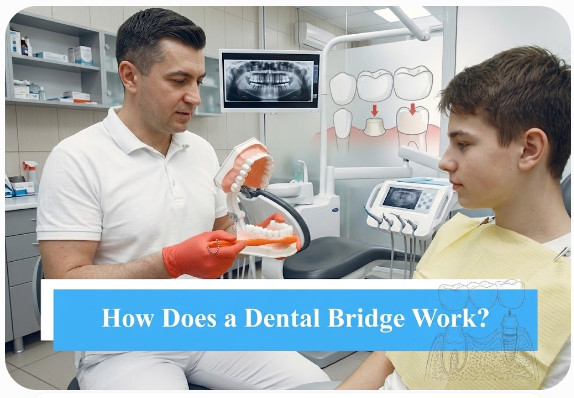
How Does a Dental Bridge Work?
A dental bridge works by using the teeth or dental implants around the empty space as support.
For example, if you have one missing tooth between two healthy teeth, a traditional bridge may use those two teeth as supports. The supporting teeth are prepared so crowns can be placed over them. The artificial tooth sits between these crowns and fills the gap.
Once the bridge is securely fitted, it functions much like a natural tooth. You can use it to bite and chew food, while the bridge also helps maintain the shape of your smile.
The bridge does not grow into the jawbone like a natural tooth root or dental implant. Instead, it relies on its supporting teeth or implants to remain stable.
What Happens During the Dental Bridge Procedure?
Getting a dental bridge usually involves several steps.
1. Dental Examination
Your dentist first examines your teeth, gums, and the area where the tooth is missing. X-rays may also be taken to check the condition of the supporting teeth and the surrounding bone.
If the teeth supporting the bridge are weak or affected by decay or gum disease, these problems may need to be treated first.
2. Preparing the Supporting Teeth
For a traditional bridge, the teeth on either side of the gap are usually reshaped slightly. This creates enough space for the crowns that will support the bridge.
Your dentist will carefully prepare these teeth to ensure the final restoration fits properly.
3. Taking Impressions
Your dentist takes an impression or digital scan of your teeth. This information is used to create a bridge that matches the size, shape, and appearance of your natural teeth.
A temporary restoration may be placed while your permanent bridge is being made.
4. Fitting the Permanent Bridge
Once the permanent bridge is ready, your dentist checks its fit, shape, and appearance. If everything looks and feels right, the bridge is bonded or cemented into position.
The dentist will also check your bite to make sure the bridge does not interfere with your other teeth.
What Are the Benefits of a Dental Bridge?
Dental bridges can offer several advantages for people with missing teeth.
- Restores your smile: A bridge fills the visible gap caused by a missing tooth.
- Makes chewing easier: Replacing the missing tooth can help improve your ability to eat comfortably.
- Supports clearer speech: Missing teeth can sometimes affect pronunciation, and a bridge may help restore normal speech.
- Helps maintain tooth position: A bridge can reduce the chance of neighboring teeth drifting into the empty space.
- Provides a fixed solution: Unlike removable dentures, a fixed bridge remains in your mouth.
How Long Does a Dental Bridge Last?
The lifespan of a dental bridge depends on several factors, including the material used, your oral hygiene, your bite, and the health of the supporting teeth.
With proper care, a dental bridge can last many years. However, it is not completely maintenance-free. Brushing twice a day, cleaning around and underneath the bridge, and attending regular dental check-ups are important for protecting your restoration.
Avoiding habits such as biting very hard objects or using your teeth to open packaging can also help prevent damage.
Is a Dental Bridge Right for You?
A dental bridge can be a practical option for replacing missing teeth, but it is not suitable for everyone. Your dentist will consider the health of your gums, the condition of the supporting teeth, the number of missing teeth, and your overall dental needs.
Other options, such as dental implants or dentures, may sometimes be more appropriate.
If you have a missing tooth, speaking with a dental clinic is the best way to determine which replacement option suits your situation. A professional examination can help you understand the available treatments, expected results, and long-term care requirements.