Losing one or more teeth can affect much more than your smile. Missing teeth may make chewing difficult, change the way you speak, affect your confidence, and gradually contribute to changes in your jawbone and surrounding teeth. Fortunately, modern dentistry offers several effective ways to replace missing teeth and restore your smile.
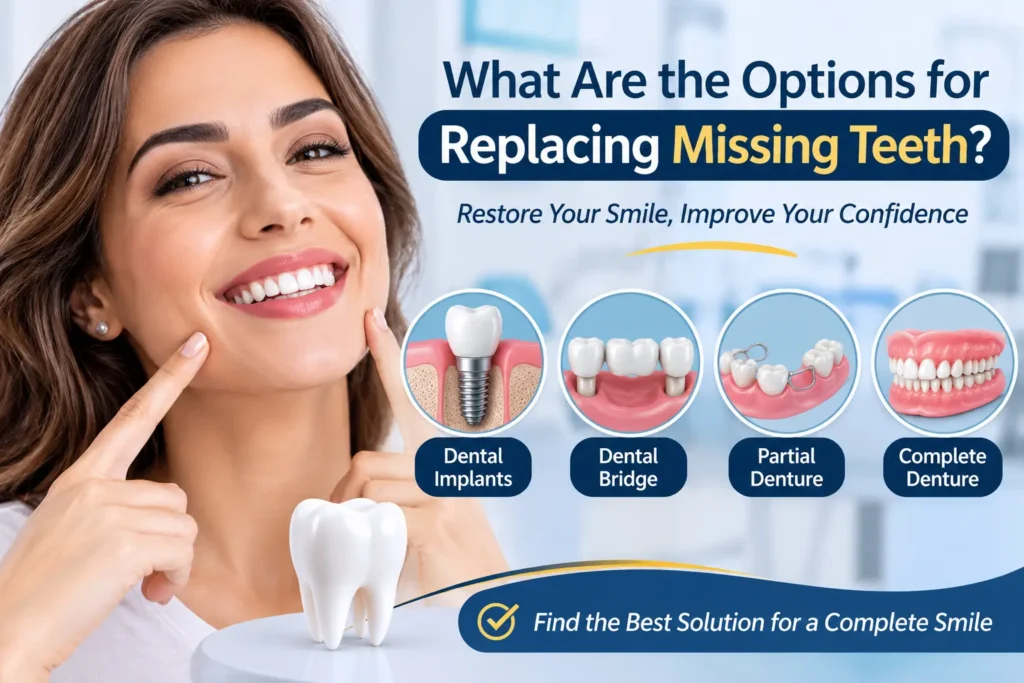
If you are wondering, what are the options for replacing missing teeth, the most common treatments include dental implants, dental bridges, full dentures, and partial dentures. Each option has different benefits, limitations, costs, and treatment requirements. The right choice depends on how many teeth you have lost, your oral health, your jawbone condition, and whether you prefer a fixed or removable replacement.
For patients in Abu Dhabi, understanding these treatments can make it easier to discuss suitable solutions with a qualified dental professional. This guide explains the main tooth replacement options, how they work, and what to consider before choosing a treatment.
Table of Contents
ToggleWhy Is Replacing Missing Teeth Important?
A missing tooth may initially seem like a cosmetic concern, especially when it is not visible when you smile. However, leaving an empty space untreated can affect your overall oral health.
Replacing missing teeth helps restore your bite, protects surrounding teeth from shifting, and supports your jawbone. When a tooth is lost, the neighboring teeth may gradually move into the empty space, potentially creating alignment problems and making cleaning more difficult.
Other possible consequences include:
- Difficulty chewing: Missing teeth can make it harder to bite and chew certain foods comfortably.
- Changes in speech: Gaps, particularly in the front teeth, may affect pronunciation.
- Shifting teeth: Adjacent teeth can move toward the empty space, affecting your bite.
- Jawbone deterioration: The jawbone may gradually lose density because it no longer receives stimulation from the missing tooth root.
- Changes in facial appearance: Multiple missing teeth can contribute to reduced facial support over time.
- Reduced confidence: Gaps in your smile may affect how comfortable you feel in social and professional situations.
Seeking professional dental advice early can help you understand your options and prevent avoidable complications.
What Are the Main Options for Replacing Missing Teeth?
The main treatment options depend on how many teeth are missing, your budget, your oral health, and whether you prefer a fixed or removable solution.
Here are the four commonly considered approaches to replacing missing teeth.
1. Dental Implants: A Long-Term Solution for Missing Teeth
Dental implants are one of the most popular options for replacing missing teeth because they are designed to function similarly to natural teeth. They consist of a small titanium or other biocompatible metal post that is surgically placed into the jawbone. Once the implant integrates with the bone, a custom-made dental crown is attached to complete the restoration.
How Dental Implants Work
The dental implant acts as an artificial tooth root. During the procedure, a dentist or qualified implant specialist places the implant into the jawbone. After a healing period, the implant connects with the surrounding bone through a process called osseointegration.
An abutment connects the implant to the final dental crown, which is designed to match the appearance and shape of your natural teeth.
Who Is a Good Candidate?
Dental implants may be suitable for people who:
- Have lost one or several teeth.
- Have sufficient jawbone density to support an implant.
- Have healthy gums or are willing to treat existing gum disease.
- Want a fixed, natural-looking replacement.
- Prefer not to place crowns on healthy neighboring teeth.
A dentist will assess your oral health, medical history, gum condition, and bone structure before recommending treatment.
Advantages of Dental Implants
- Natural appearance: Custom crowns are designed to blend with surrounding teeth.
- Improved chewing: Implants provide stable support for biting and chewing.
- Jawbone support: Implants transmit functional forces to the jawbone and can help limit bone loss in the area.
- Protection for neighboring teeth: A single implant generally does not require reshaping adjacent healthy teeth.
- Long-term functionality: With proper care and professional monitoring, implants can provide a durable tooth replacement.
Potential Disadvantages
Dental implants also have some considerations. They require oral surgery, and the healing process may take several months. The initial investment is generally higher than that of conventional dentures or bridges. Some patients may also require additional procedures, such as bone grafting, before implant placement.
How Much Do Dental Implants Cost in Abu Dhabi?
The price of dental implants in Abu Dhabi varies according to the implant system, number of missing teeth, crown material, dentist’s expertise, and whether additional procedures are required. Patients should request a detailed quotation that explains whether the consultation, imaging, implant post, abutment, and final crown are included.
2. Dental Bridges: A Fixed Alternative to Dental Implants
A dental bridge is another common solution for replacing one or a few missing teeth. Unlike dental implants, a conventional bridge does not require a surgically placed artificial tooth root. Instead, it uses neighboring teeth to support an artificial replacement tooth.
How Dental Bridges Work
A false tooth, known as a pontic, fills the empty space. The bridge is supported by crowns fitted over the natural teeth on either side of the gap. These supporting teeth are called abutment teeth.
The dentist prepares the supporting teeth, takes impressions or digital scans, and arranges for a custom bridge to be manufactured. Once ready, the bridge is fitted and secured in place.
Who Should Consider Dental Bridges?
A dental bridge may be suitable for people who:
- Have one or several missing teeth next to each other.
- Have healthy neighboring teeth that can support the bridge.
- Prefer a fixed tooth replacement without implant surgery.
- Want a treatment that can often be completed in fewer visits than implant treatment.
Benefits of Dental Bridges
- They remain fixed in the mouth and do not need to be removed daily.
- They restore the appearance of missing teeth.
- They help improve chewing and speaking.
- Treatment is often completed faster than conventional implant treatment.
- They can be an alternative for patients who are not suitable for implants.
Disadvantages of Dental Bridges
Traditional dental bridges require the supporting teeth to be reshaped, which means some healthy tooth structure may need to be removed. They also do not replace the missing tooth root, so they do not provide the same stimulation to the jawbone as dental implants.
Special cleaning methods, such as floss threaders or interdental brushes, may be necessary to keep the area underneath the bridge clean.
Different Types of Dental Bridges
There are several types of dental bridges available in modern dentistry.
- Traditional Three-Unit Bridge: This design uses two crowned neighboring teeth to support one artificial tooth in the middle. It is commonly used when a single tooth is missing between two suitable supporting teeth.
- Maryland or Resin-Retained Bridge: This bridge uses small metal or porcelain wings bonded to the back of neighboring teeth. It generally requires less preparation and is often considered for replacing front teeth.
- Implant-Supported Bridge: Instead of relying on natural teeth, this bridge is anchored by dental implants. It can replace several missing teeth in a row without requiring a separate implant for every replacement tooth.
The best bridge design depends on the location of the missing teeth, the condition of neighboring teeth, and your bite.
3. Dentures and Partial Dentures: Removable Tooth Replacement Options
Dentures are removable dental appliances designed to replace several missing teeth or an entire set of teeth. They are commonly considered by patients looking for a non-surgical tooth replacement option or a solution with a lower initial cost.
Dentures can be made using acrylic materials, metal frameworks, or combinations of different dental materials. They are customized to fit the patient’s mouth and restore basic functions such as chewing and speaking.
How Dentures Work
Dentures rest on the gums and may use the remaining natural teeth for additional support. Depending on the design, they can replace a few missing teeth or an entire upper or lower dental arch.
A dentist takes impressions or digital scans of your mouth to create a denture that fits your oral structures. Adjustments may be required to improve comfort, stability, and function.
Who Can Benefit from Dentures?
Dentures may be suitable for people who:
- Have lost several teeth or all teeth in an arch.
- Prefer a removable tooth replacement.
- Are not suitable candidates for conventional dental implants.
- Want a more affordable initial treatment option.
- Need a temporary replacement while waiting for another dental procedure.
Advantages of Dentures
- Lower initial cost compared with many implant treatments.
- No implant surgery is required for conventional dentures.
- They can replace several or all missing teeth.
- They can be adjusted or modified when necessary.
- They can restore facial support and improve the appearance of your smile.
Disadvantages of Dentures
Although dentures are useful, they also have some limitations:
- They may move while speaking or eating, especially if the fit is poor.
- They need to be removed for daily cleaning.
- They may require adjustments or replacement as the jawbone and gums change.
- They do not prevent the jawbone shrinkage associated with missing tooth roots.
- Some patients need time to become comfortable wearing them.
Different Types of Dentures
There are several denture options available depending on the number of missing teeth and the patient’s oral condition.
Removable Partial Dentures
Partial dentures replace several missing teeth while preserving the remaining natural teeth. They may use metal clasps or other attachments to remain in position. They are useful when a patient has multiple gaps but still has some healthy natural teeth.
Conventional Full Dentures
Full dentures replace all teeth in the upper or lower jaw. They are designed to rest on the gums and restore the appearance and basic function of a complete dental arch.
Temporary Flipper Dentures
A flipper is a lightweight acrylic removable appliance that replaces one or a small number of missing teeth. It is commonly used as a temporary solution while the mouth heals or until a permanent restoration is ready.
4. Implant-Supported Dentures: Combining Stability and Convenience
Implant-supported dentures offer another option for people who have lost most or all of their teeth. They combine dental implants with a removable or fixed prosthetic restoration, depending on the treatment design.
Unlike conventional dentures, which rely mainly on the gums for support, implant-supported dentures attach to implants placed in the jawbone.
How Do Implant-Supported Dentures Work?
A dentist places a selected number of implants into the jawbone. After the healing period, special attachments connect the denture to the implants. These attachments help improve stability and reduce unwanted movement during everyday activities.
Some implant-supported dentures can be removed by the patient for cleaning, while other full-arch restorations are designed to remain fixed and are removed only by a dental professional.
Benefits of Implant-Supported Dentures
- Better stability compared with many conventional dentures.
- Improved comfort when eating and speaking.
- Reduced movement during daily activities.
- Implant support can help maintain bone in the areas where implants are placed.
- Suitable for selected patients who have lost most or all of their natural teeth.
However, this treatment requires surgery, careful planning, and ongoing maintenance. Your dentist will determine whether you have sufficient bone and suitable oral health for the procedure.
How to Choose the Best Tooth Replacement Option in Abu Dhabi
Choosing between dental implants, bridges, and dentures is not simply about selecting the most affordable treatment. Each solution has different clinical requirements and long-term considerations.
Before making a decision, your dentist will usually evaluate the following factors.
| Important factor | Why it matters |
| Number of missing teeth | Determines the type and design of restoration |
| Jawbone condition | Helps establish implant suitability |
| Gum health | Healthy gums are important for successful treatment |
| Neighboring teeth | Their condition affects bridge suitability |
| Budget | Helps compare initial and long-term costs |
| Personal preference | Determines whether fixed or removable treatment is preferred |
Consider Your Budget and Long-Term Needs
Conventional dentures may have a lower initial cost, while dental implants generally involve a higher upfront investment. However, the best choice should consider maintenance, repairs, replacement needs, and expected functionality over time.
Ask your dentist for a complete treatment estimate rather than comparing prices based on one component alone.
Evaluate Your Oral Health
Existing gum disease, untreated decay, and insufficient jawbone density can affect your treatment options. Some conditions may need to be addressed before proceeding with a bridge or implant.
Think About Comfort and Convenience
If you prefer a restoration that stays in place, a dental implant or bridge may be worth discussing. If you prefer a non-surgical and removable option, partial or full dentures may be more appropriate.
Get a Professional Dental Assessment
A proper dental examination helps identify the most suitable treatment. Your dentist may recommend X-rays or a CBCT scan to evaluate the jawbone and surrounding anatomical structures before implant treatment.
For patients in Abu Dhabi, it is also important to choose a qualified dental professional with the appropriate Department of Health (DoH) clinical privileges for the procedures they perform.
Department of Health Abu Dhabi+1
Dental Implants vs Dental Bridges vs Dentures: Which Is Better?
Understanding the differences between tooth replacement treatments can help you prepare for your dental consultation.
| Feature | Dental Implants | Dental Bridges | Dentures |
| Fixed or removable | Usually fixed | Fixed | Removable |
| Surgery required | Yes | Usually no | No, for conventional dentures |
| Jawbone support | Helps maintain bone around implant | Does not replace tooth root | Does not prevent bone shrinkage |
| Treatment duration | Several months in many cases | Often a few visits | Depends on design and adjustments |
| Initial investment | Generally higher | Moderate to high | Generally lower |
| Best for | Single or multiple missing teeth | One or several adjacent missing teeth | Multiple or all missing teeth |
So, which option is best?
There is no single solution that works for everyone. Dental implants may be an excellent choice for patients seeking a fixed replacement that supports the jawbone. Dental bridges can be suitable when neighboring teeth can provide support, while dentures offer a removable and often more affordable alternative.
Your dentist can explain the benefits and limitations of each option based on your individual condition.
What Is the Cost of Replacing Missing Teeth in Abu Dhabi?
The cost of replacing missing teeth in Abu Dhabi depends on the treatment selected and the complexity of your dental condition. A single dental implant, a three-unit bridge, and a complete denture involve different materials, procedures, and laboratory work.
Several factors influence the overall treatment cost:
- Number of missing teeth: Replacing one tooth is generally different in cost from restoring an entire dental arch.
- Treatment type: Implants, bridges, and dentures have different clinical and laboratory requirements.
- Materials used: Titanium implants, zirconia crowns, porcelain bridges, and acrylic dentures can have different costs.
- Additional procedures: Bone grafting, gum treatment, extractions, and other preparatory procedures may increase the total cost.
- Dentist’s experience: The qualifications and expertise of the dental professional can influence treatment fees.
- Diagnostic requirements: Dental X-rays, CBCT scans, and treatment planning may be included or charged separately.
Before starting treatment, ask your dental clinic for a transparent quotation that includes all necessary stages. This helps you understand the complete financial commitment and avoid unexpected expenses.
What Happens During a Tooth Replacement Consultation?
If you have missing teeth and are considering treatment, the first step is a professional dental consultation.
Although the exact process depends on your condition, a typical consultation may include the following stages:
- Examination of Your Teeth and Gums
The dentist examines your remaining teeth, gums, bite, and the areas where teeth are missing. This helps identify any underlying dental problems that need attention.
- Dental Imaging
X-rays or other imaging techniques may be recommended to assess the jawbone, tooth roots, and surrounding structures. A CBCT scan may be particularly useful when planning dental implants.
- Discussion of Treatment Options
Your dentist explains whether implants, bridges, dentures, or implant-supported restorations may be appropriate. You can discuss your preferences, concerns, and budget.
- Personalized Treatment Plan
After evaluating your oral health, the dental team prepares a treatment plan outlining the recommended procedure, expected timeline, costs, and follow-up requirements.
- Treatment and Follow-Up
Once you agree on a suitable treatment, the procedure is scheduled. Regular follow-up appointments help monitor healing, comfort, and the condition of your replacement teeth.
How Can You Maintain Your Replacement Teeth?
Replacing missing teeth is only part of maintaining good oral health. Proper daily care and regular dental visits help keep your restoration comfortable and functional.
Here are some useful tips:
- Brush twice daily using a soft-bristled toothbrush.
- Clean between your natural teeth and around dental restorations.
- Use floss threaders or interdental brushes to clean underneath dental bridges.
- Remove and clean removable dentures according to your dentist’s instructions.
- Avoid biting extremely hard objects that could damage restorations.
- Attend regular dental check-ups and professional cleaning appointments.
- Contact your dentist if you experience discomfort, swelling, bleeding, or looseness around a restoration.
Dental implants also require careful cleaning because the surrounding gums can develop inflammation and infection. Good oral hygiene is essential even though the artificial crown itself cannot develop tooth decay.
Why Consider Professional Tooth Replacement Treatment in Abu Dhabi?
Abu Dhabi offers access to modern dental services, including restorative dentistry, prosthodontics, dental implantology, and cosmetic dental treatments.
Patients can discuss different treatment approaches with qualified dental professionals and receive recommendations based on their oral health and individual requirements.
When choosing a dental clinic in Abu Dhabi, consider:
- Qualified and appropriately licensed dental professionals.
- Experience in restorative dentistry and tooth replacement.
- Access to suitable dental imaging and diagnostic equipment.
- Clear treatment plans and transparent pricing.
- Appropriate sterilization and patient safety practices.
- Follow-up care and maintenance support.
The goal should not simply be to fill an empty space but to restore comfortable chewing, support oral health, and achieve a natural-looking smile.
Frequently Asked Questions About Replacing Missing Teeth
1. What is the best option for replacing missing teeth?
Dental implants, bridges, and dentures are common options. Implants can provide a fixed, natural-looking replacement, bridges can restore gaps without implant surgery, and dentures can replace several or all missing teeth. The best choice depends on your oral health, budget, and treatment preferences.
2. Can I replace a missing tooth without surgery?
Yes. Dental bridges and removable partial dentures can replace missing teeth without requiring dental implant surgery. A Maryland bridge may also be suitable in selected cases because it generally requires minimal preparation of neighboring teeth.
3. Are dental implants better than dentures?
Dental implants provide fixed support and help maintain bone around the implant. Conventional dentures are removable, generally have a lower initial cost, and do not require implant surgery. Neither option is automatically better for every patient.
4. How long does it take to replace a missing tooth?
The timeline depends on the treatment. A dental bridge may be completed in a few appointments, while implant treatment can take several months because the implant needs time to integrate with the jawbone. Denture treatment also requires impressions, fabrication, fitting, and possible adjustments.
5. Can I replace multiple missing teeth with dental implants?
Yes. Multiple missing teeth can be replaced using individual implants or an implant-supported bridge. For patients missing most or all of their teeth, full-arch implant-supported restorations may also be considered.
6. Do dentures look like natural teeth?
Modern dentures are customized to match the patient’s facial features, gum appearance, and desired tooth shape. When properly designed and fitted, they can provide a natural-looking smile.
7. What happens if I do not replace a missing tooth?
Leaving a missing tooth untreated may contribute to neighboring teeth shifting, bite changes, chewing difficulties, and jawbone loss in the affected area. A dental assessment can help determine whether replacement is advisable.
8. How much does it cost to replace missing teeth in Abu Dhabi?
The price varies according to the number of missing teeth, treatment method, materials, and additional procedures. Request an individual quotation from a dental clinic after an examination to understand the complete cost.
9. Are dental implants painful?
Implant placement is generally performed using local anesthesia, so patients should not feel sharp pain during the procedure. Some soreness, swelling, or discomfort can occur afterward. Your dentist will provide appropriate aftercare instructions.
10. Can smokers get dental implants?
Smoking does not automatically rule out dental implants, but it can increase the risk of healing complications and implant failure. Patients should discuss their smoking habits with their dentist before treatment.
Restore Your Smile with the Right Tooth Replacement Option in Abu Dhabi
Missing teeth do not have to affect your confidence, comfort, or everyday activities permanently. With modern restorative dentistry, several treatment options can help you regain a functional and attractive smile.
Whether you need a single dental implant, a fixed dental bridge, partial dentures, or a complete tooth replacement solution, the first step is understanding what works best for your oral health.
Looking for professional tooth replacement treatment in Abu Dhabi?