
These different recommendations do not necessarily contradict one another. Orthodontic treatment should be timed according to the problem being treated, the child’s dental development and whether early intervention provides a meaningful advantage.
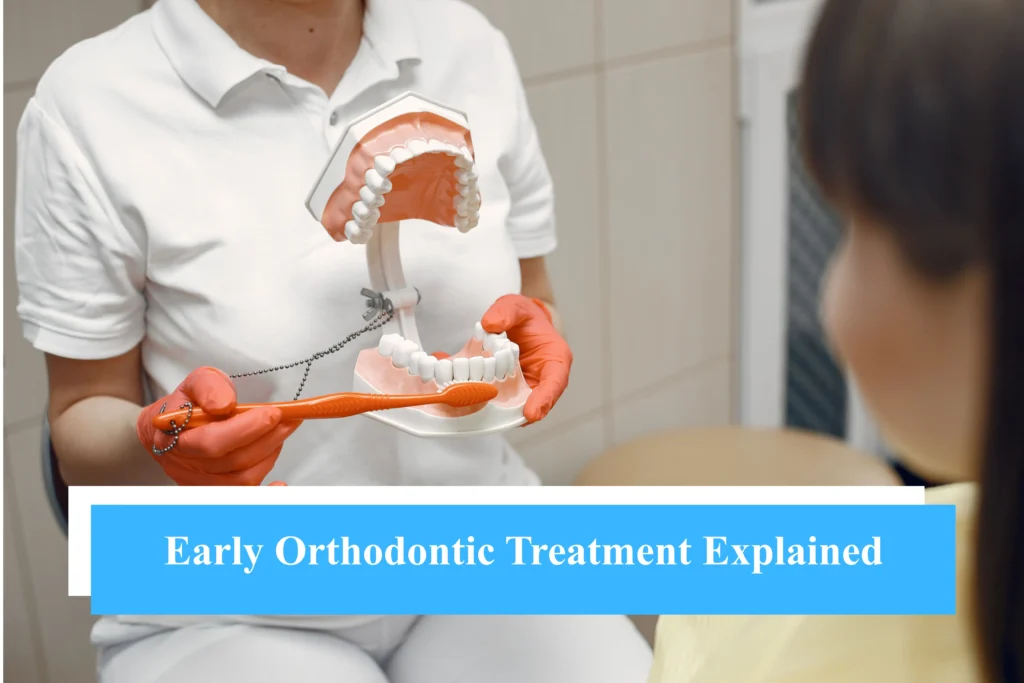
Early orthodontic treatment also called interceptive orthodontics or phase-one orthodontic treatment is treatment performed while a child still has a mixture of baby and permanent teeth.
Its purpose is not simply to make the front teeth look straighter at an earlier age. It is used selectively to address a developing problem involving the teeth, bite, eruption pattern or jaws.
The AAO recommends that children have their first orthodontic check-up by age seven. However, the organization also emphasizes that not every child requires immediate or two-phase treatment. Many conditions can be treated successfully in one comprehensive phase later.
Table of Contents
ToggleWhat Does “Early” Mean in Orthodontics?
Early treatment generally takes place before all the permanent teeth have erupted. The child may have permanent front teeth and first permanent molars while still retaining several baby teeth.
The exact age varies. One child may start at six or seven, while another begins at nine or ten. Developmental stage is more important than age alone.
The orthodontist considers:
- Which teeth have erupted
- Which baby teeth remain
- The child’s jaw growth
- The severity of the bite problem
- The eruption paths of permanent teeth
- The amount of available space
- Facial proportions
- Oral habits
- Cooperation and oral hygiene
- Whether delaying treatment could make the condition more difficult to manage
The AAPD’s best-practice guidance emphasizes comprehensive examination and diagnosis when managing developing teeth and occlusion. Treatment timing should be based on clear priorities rather than a one-size-fits-all schedule.
What Is Phase-One Treatment?
Phase one is the active early-treatment stage.
It may involve braces on a limited number of teeth, an expander, a removable appliance, a habit-breaking appliance, space maintenance or another device selected for the child’s condition.
Treatment usually has a specific objective, such as:
- Correcting a crossbite
- Improving a functional jaw shift
- Reducing severe front-tooth protrusion
- Preserving space for permanent teeth
- Guiding selected teeth toward a better eruption path
- Managing the effects of an oral habit
- Addressing an underbite in an appropriate growing patient
- Creating room for blocked teeth
- Improving a traumatic bite
After phase one, active treatment stops and the child enters a monitoring or retention period while additional permanent teeth erupt.
What Is Phase Two?
Phase two is comprehensive orthodontic treatment performed after most or all permanent teeth have erupted.
It may involve full braces or clear aligners. Its goals commonly include:
- Aligning the permanent teeth
- Correcting remaining crowding or spacing
- Improving how the upper and lower teeth meet
- Coordinating the dental arches
- Refining the final bite
- Improving stability and appearance
A child who completes phase one may still require phase two. Early treatment is not always intended to eliminate future braces. Instead, it may address one important problem while the child is still growing.
Parents should ask whether the proposed early treatment is expected to:
- Eliminate later treatment
- Shorten later treatment
- Make later treatment less complex
- Reduce a particular health or injury risk
- Improve function now
- Create a more favorable developmental environment
Does Every Child Need Two Phases?
No.
The AAO specifically states that two-phase orthodontic treatment is not necessary for every child. Many orthodontic problems can be treated in a single comprehensive phase.
Starting treatment early without a meaningful clinical reason may increase total treatment time, cost and the number of years a child must maintain orthodontic appliances.
For some children, the most appropriate plan is:
- An initial assessment around age seven.
- Periodic monitoring.
- One phase of treatment after more permanent teeth have erupted.
For others, early intervention may provide a genuine advantage.
Which Problems May Benefit From Early Treatment?
Posterior crossbite with a jaw shift
A posterior crossbite occurs when the upper back teeth bite inside the lower back teeth. Some children shift the lower jaw to one side to make the teeth fit together.
An orthodontist may recommend early correction to improve function and create a more symmetrical closure pattern.
Anterior crossbite
An upper front tooth may erupt behind a lower front tooth. Depending on the cause and available space, early correction may prevent abnormal wear or gum problems.
Developing underbite
An underbite may result from tooth position, jaw growth or both. Early treatment may be considered in selected growing patients, although future growth can be difficult to predict and additional treatment may still be necessary.
Severe protrusion
Very prominent front teeth may be more exposed to accidental injury. Treatment may be considered to reduce the prominence or improve lip coverage.
Significant crowding or blocked eruption
An orthodontist may intervene when lack of space is preventing a permanent tooth from erupting normally or directing it toward an unfavorable position.
Early loss of baby teeth
When a baby tooth is lost too soon, neighboring teeth may move into the space intended for the permanent successor. A space maintainer may be considered in selected cases.
Delayed or abnormal eruption
Teeth may be missing, impacted, blocked by extra teeth or developing along an unusual path. Early diagnosis helps the dental team determine whether monitoring, removal of an obstruction, space creation or another treatment is appropriate.
Persistent oral habits
Long-lasting thumb or finger sucking may influence the position of the front teeth and shape of the dental arches. Habit counseling or an appliance may be considered when the habit continues and is affecting development.
The AAPD identifies crossbites, space maintenance, oral habits, eruption disturbances, ankylosed teeth and extra teeth among the issues relevant to management of the developing dentition.
What Are the Potential Benefits?
When appropriately recommended, early orthodontic treatment may:
- Improve the way the jaws close
- Correct a functional shift
- Reduce abnormal tooth wear
- Create or preserve eruption space
- Guide selected permanent teeth
- Reduce the prominence of vulnerable front teeth
- Improve chewing in certain cases
- Address a harmful habit
- Improve a child’s confidence when appearance is causing significant distress
- Make later comprehensive treatment more manageable
- Reduce the need for a more complicated correction in selected cases
The key phrase is in selected cases. An advantage that applies to one type of malocclusion may not apply to another.
An early assessment is valuable even when no treatment begins because it allows the orthodontist to monitor changes and select a more appropriate starting point.
What Are the Limitations?
Early treatment cannot control every aspect of facial growth or guarantee a perfect result.
Possible limitations include:
- A second phase may still be required.
- Jaw growth may continue in an unexpected direction.
- Permanent teeth may still erupt with crowding or rotation.
- The child must cooperate with removable appliances.
- Oral hygiene may become more difficult.
- Appliances can break or be lost.
- Treatment can become longer when goals are unclear.
- Corrected problems may relapse without retention.
- Early improvement does not guarantee that future tooth extractions or jaw surgery will never be considered.
Parents should be cautious when early treatment is presented as a guaranteed way to prevent every future procedure.
Common Early Orthodontic Appliances
Limited braces
Brackets may be placed on a small number of permanent teeth to improve alignment, create space or correct a crossbite.
Palatal expander
An expander may be used to widen the upper dental arch in an appropriate patient. Different designs produce different types of change, so “an expander” is not one uniform treatment.
Removable appliance
A removable device may move selected teeth, guide development or retain a correction. Success depends heavily on the child wearing it as instructed.
Space maintainer
A space maintainer holds an area open after premature loss of a baby tooth. Not every early tooth loss requires one; the dentist or orthodontist considers the tooth involved, eruption stage and available space.
Habit appliance
An appliance may be recommended when a persistent habit is affecting the teeth and simpler behavioral approaches have not succeeded.
Functional appliance
Certain removable or fixed appliances are designed to influence tooth position and jaw relationships during growth. Results and suitability depend on the type of problem, developmental timing and patient cooperation.
Face mask or extraoral appliance
Some selected underbite or jaw-growth problems may be treated using an appliance that applies force from outside the mouth. The orthodontist should explain the expected benefit, wearing schedule and limitations.
What Happens Before Treatment Begins?
A proper orthodontic diagnosis may involve:
- Medical and dental history
- Facial examination
- Assessment of jaw movement
- Examination of the bite
- Evaluation of crowding and spacing
- Photographs
- Digital scans or impressions
- Appropriate dental X-rays
- Review of tooth eruption
- Assessment of oral hygiene
- Discussion of habits and symptoms
- A written or clearly explained treatment plan
The orthodontist should identify the problem being treated rather than recommending an appliance without a defined diagnosis.
Questions Parents Should Ask
Before agreeing to phase-one treatment, ask:
- What exact problem does my child have?
- Why should it be treated now?
- What might happen if we wait?
- Is observation a reasonable option?
- What is the objective of this phase?
- How will success be measured?
- How long is treatment expected to last?
- Will my child probably need phase two?
- Could the same problem be treated in one later phase?
- What are the risks and limitations?
- What cooperation is required?
- What happens if the appliance is not worn?
- Will retainers be required?
- How much will the full treatment process cost?
- Are phase-one and phase-two fees separate?
Clear answers help families distinguish necessary interceptive care from treatment that may reasonably be delayed.
Does Early Treatment Prevent Tooth Extraction?
Sometimes space management or expansion may reduce the likelihood of extracting permanent teeth, but this cannot be guaranteed in every case.
The need for extraction depends on:
- The severity of crowding
- Tooth size
- Jaw size
- Facial profile
- Gum and bone support
- Bite relationships
- Tooth position
- Treatment goals
- Future growth
Parents should be cautious of absolute promises that an early appliance will always prevent extractions.
Does Early Treatment Prevent Jaw Surgery?
Early treatment may improve certain growing jaw relationships, but it cannot guarantee that corrective jaw surgery will never be needed.
Some skeletal growth patterns become more pronounced during adolescence. A child’s response to treatment and future growth cannot always be predicted with complete accuracy.
An orthodontist should explain whether treatment is intended to correct a dental problem, influence growth, camouflage a jaw discrepancy or reduce the severity of a future problem.
How Long Does Phase-One Treatment Take?
The duration varies according to the problem and appliance. It should generally continue only as long as needed to achieve the defined early objective.
After active treatment, a child may wear a retainer or remain under observation while the permanent teeth continue to erupt.
Long periods of treatment without clear progress should prompt parents to ask:
- Which goal is still being pursued?
- Has the original objective been achieved?
- Is active treatment still necessary?
- When will the observation period begin?
- What determines the timing of phase two?
Oral Hygiene During Early Treatment
Children with orthodontic appliances must clean carefully around brackets, wires and appliance components.
Poor plaque control may lead to:
- Gum inflammation
- Bleeding
- Bad breath
- Tooth decay
- White marks around brackets
- Delayed treatment
- Uncomfortable gums
Children should continue regular dental check-ups during orthodontic care. The orthodontist moves and aligns the teeth, while the family dentist continues to manage preventive care, decay and general oral health.
Brushing twice daily with fluoride toothpaste and cleaning between the teeth remain essential.
Diet and Appliance Care
Children may need to avoid:
- Hard sweets
- Ice
- Popcorn kernels
- Sticky toffee
- Chewing gum when prohibited
- Biting directly into very hard foods
- Chewing pens or pencils
- Using the teeth to open packaging
Broken appliances can interrupt treatment and may injure the cheeks or gums.
Removable appliances should be stored in their case rather than wrapped in tissue, where they can easily be discarded.
Signs That Should Prompt an Early Assessment
Arrange an orthodontic evaluation when a child has:
- An underbite
- A crossbite
- A jaw that shifts during closure
- Severe crowding
- Prominent front teeth
- Difficulty biting or chewing
- Early or late loss of baby teeth
- Teeth erupting in unusual positions
- A permanent tooth that does not appear
- Persistent thumb or finger sucking
- Frequent cheek biting
- An open bite
- Facial asymmetry
- Teeth that do not meet properly
- Significant concern about dental appearance
Parents do not have to wait for a routine referral when an obvious concern is present. The AAO states that families can contact an orthodontist directly for an assessment.
Myths About Early Orthodontics
Myth: Every seven-year-old needs braces
Age seven is the recommended age for assessment, not automatic treatment.
Myth: Early treatment always prevents future braces
Many children still need a second comprehensive phase after the permanent teeth erupt.
Myth: It is always better to start as early as possible
Starting at the correct developmental stage is more important than starting at the youngest possible age.
Myth: Straight front teeth mean the bite is healthy
A child can have relatively straight visible teeth and still have a crossbite, jaw discrepancy, impacted tooth or eruption problem.
Myth: Waiting is always safer
For many children, waiting is appropriate. In selected conditions, however, delaying care may allow a functional or eruption problem to become more difficult to manage.
Myth: Two-phase treatment is better than one phase
Two-phase treatment is appropriate only when the early phase has a meaningful objective that cannot be addressed as effectively later.
Frequently Asked Questions
Is phase-one treatment painful?
Children may feel pressure or temporary tenderness after an appliance is fitted or adjusted. Severe pain, swelling or injury should be reported to the orthodontist.
Can clear aligners be used for early treatment?
In selected cases, yes. Suitability depends on the problem, the child’s development and the ability to wear aligners consistently.
Will my child need a retainer after phase one?
Possibly. Retention depends on the correction achieved and how the teeth and jaws are expected to develop.
What happens between phase one and phase two?
The orthodontist monitors growth and eruption. The child may wear a retainer or have no active appliance during this period.
How do I know whether early treatment is genuinely necessary?
Ask for a clear diagnosis, treatment objective, alternatives and explanation of what is likely to happen without immediate intervention. A second professional opinion may be helpful when the proposed treatment is extensive or the reasoning is unclear.